Advanced Search

Advanced Search

Current Filters

Filter your query

Publication Types

Other

to

Surveys

/

How Health Insurance Coverage Denials Affect Americans

Findings from the Commonwealth Fund 2025 Affordability Survey and Focus Groups
Woman in PET-CT machine

Katie Doble receives a PET-CT scan to determine if she remains clear of cancer at UCHealth University of Colorado Hospital in Aurora, Colo. One in five privately insured adults in the United States say they or a family member have been denied coverage for doctor-recommended medical care in the past year. Photo: Kevin Mohatt for the Washington Post via Getty Images

Katie Doble receives a PET-CT scan to determine if she remains clear of cancer at UCHealth University of Colorado Hospital in Aurora, Colo. One in five privately insured adults in the United States say they or a family member have been denied coverage for doctor-recommended medical care in the past year. Photo: Kevin Mohatt for the Washington Post via Getty Images

Toplines
  • One in five privately insured U.S. adults report coverage denials for doctor-recommended care

  • Coverage denials for doctor-recommended services can delay needed care, make patients’ health problems worse, and increase medical expenses and debt

U.S. adults with private insurance are anxious and frustrated about getting and paying for the care they need through their health plan. One of patients’ main concerns is uncertainty about whether their insurer will cover a health procedure or prescription drug that their doctor says they need, particularly for a serious medical condition.

Insurers can deny coverage for a variety of reasons. For example, they might deem a treatment or procedure to be medically unnecessary. Payment can also be denied for care delivered by an out-of-network provider, or for services the plan simply doesn’t cover. Administrative or billing errors can also trigger a denial.1

In this brief, we report findings from the Commonwealth Fund 2025 Affordability Survey on patients’ and families’ experiences with insurance coverage denials. We pair these findings with those from focus groups on the same topic. We examine experiences with two types of denials: those that occur before care is received, which we refer to as prior authorization denials, and those that occur after care has been provided, which we refer to as claim denials.

SSRS interviewed a nationally representative sample of 6,353 adults ages 19 to 64 from July 22 to October 27, 2025. Our analysis focused on 4,589 respondents with private insurance, either through an employer or the Affordable Care Act (ACA) marketplaces and individual insurance market. To gain a deeper understanding of people who experienced coverage denials, SSRS also conducted eight online focus groups with a total of 45 privately insured adults across the United States. To learn more about the survey and the focus groups, see “How We Conducted This Survey.”

Highlights

  • Experience with denials: One in five (21%) U.S. working-age adults with private insurance reported that they or a family member had experienced an insurance company denial of coverage for medical care recommended by a doctor in the past year, either before or after the care was provided.
  • Treatment delays: Forty-one percent of people who experienced a prior authorization denial said it led to a delay in medical care, and more than a quarter (28%) said a health problem got worse because of it. More than 60 percent said the denial caused worry and anxiety.
  • Out-of-pocket costs and medical debt: Among people who experienced a claim denial, nearly 70 percent said it cost them or their household more money. More than two in five (43%) adults who experienced a claim denial reported that the denial led to medical debt that they are still paying off.
  • Appeals: Only about half of those who experienced a denial appealed the decision, citing uncertainty over their right to do so and whether it would make a difference if they did, as well as confusion about who to contact.

Survey and Focus Group Findings

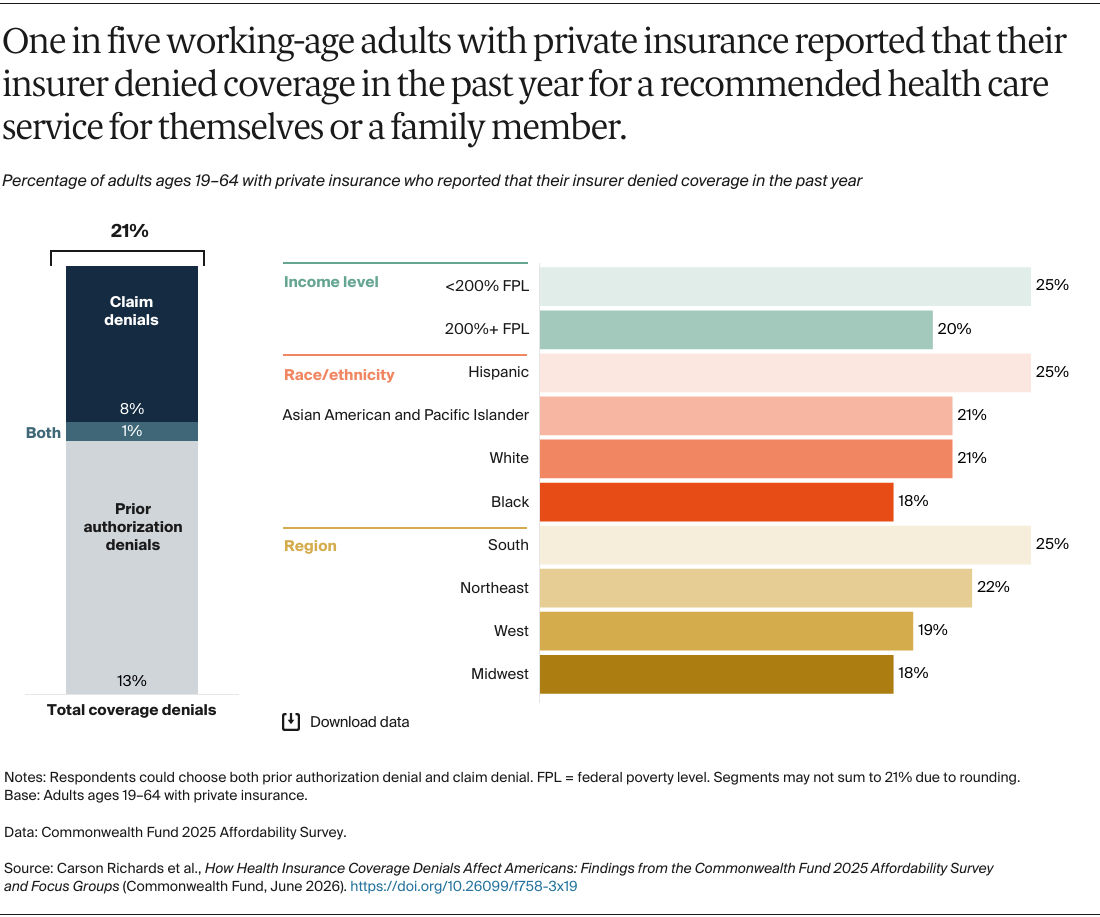
Richards_coverage_denials_Exhibit_01

Who experiences coverage denials?

We asked U.S. working-age adults with private insurance coverage if their insurance, or the insurance of a household member, denied coverage for recommended medical care. One in five (21%) working-age adults reported a coverage denial in the past year for a health care service recommended by a provider, either their own or that of a family member. Thirteen percent reported a prior authorization denial, 8 percent reported a claim denial, and 1 percent experienced both a prior authorization denial and a claim denial.

In focus groups with people who reported having a prior authorization or claim denial, participants reported that coverage denials, and the process of challenging them, often had significant consequences for their finances, health, and well-being.

Denied: John’s Story

John, who is in his early 60s, had surgery on both rotator cuffs. His provider recommended physical therapy (PT) as part of his recovery. For the first surgery, his PT was fully covered. After the second surgery one year later, his insurance company denied coverage for PT.

He plans to appeal the denial through his PT provider. “I’m going back to the physical therapist to ask them to resubmit my application, see if they can reword it and make a better case for me.”

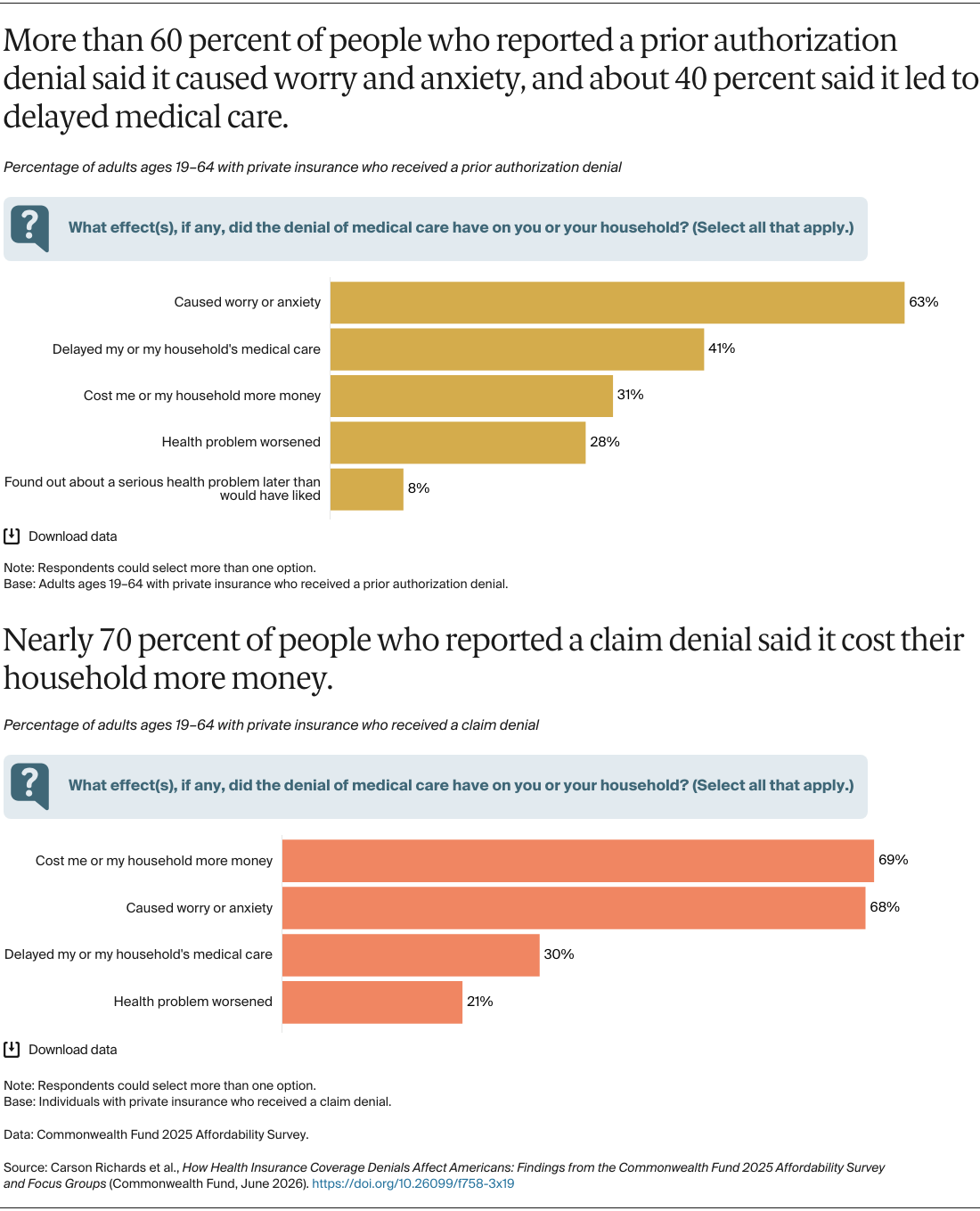
Richards_coverage_denials_Exhibit_02

Coverage denials can harm peoples’ health and financial well-being. Over half (63%) of working-age adults with private insurance who experienced a prior authorization denial of coverage for medical care said it caused them or their households worry or anxiety. About 40 percent said that a prior authorization denial delayed medical care, and more than a quarter (28%) said that their health problem worsened as a result. Three in 10 said they spent more money because of the prior authorization denial. That’s because when coverage is denied, some patients may elect to pay for their care out of pocket.

Denied: Sally’s Story

Sally, who is in her 40s, was due for a routine mammogram. Her gynecologist recommended that she also get an ultrasound, because she has dense breasts. Sally was told the ultrasound would be covered when she called prior to her appointment, but after she had the procedure, her insurance company refused to pay for it.

Sally says she’s still fighting the claim denial, but she’s feeling discouraged. She feels her insurance provider “will try to wiggle out of anything they can.”

Having a claim denied after receiving care leaves patients and their families on the hook for medical bills they didn’t expect. Nearly 70 percent of people who experienced a claim denial said that the denial cost them or their household more money. Thirty percent reported the denial had led to a delay in their health care, possibly because they were reluctant or financially unable to seek additional care. One in five people said their health problem worsened as a result.

For focus group participants, coverage denials were often a source of financial stress. Some patients who appealed their insurer’s denial said their health care provider had threatened to send their overdue bills to collections while they awaited their insurance company’s decision. They feared that their credit score would suffer if they continued waiting for an insurer’s decision.

I’m very busy right now. I haven’t pursued any avenue. I just paid for [the test]. I didn’t want to; I was afraid, and I haven’t learned much about credit, how it affects me, or whether it affects me. . . . I decided not to proceed with any legal means. I just paid it.

Oscar, a man in his 30s who had a claim denial for lab tests

Coverage denials also affected peoples’ subsequent medical care decisions. Some focus group participants said they were avoiding getting needed medical care because of their coverage denial. Following a coverage denial, one participant stopped seeking care for her ongoing health issue, which remains unresolved. Others are postponing future checkups or procedures because of how uncertain insurance coverage can be. Even just the anticipation of coverage denials and unexpected bills led some participants to avoid seeking care.

I feel like I’ve been unable to address the initial issue. . . . I don’t want to go back [to the doctor] with the very high chance [care] gets denied again.

Mary, a woman in her 20s who had a claim denial for lab tests

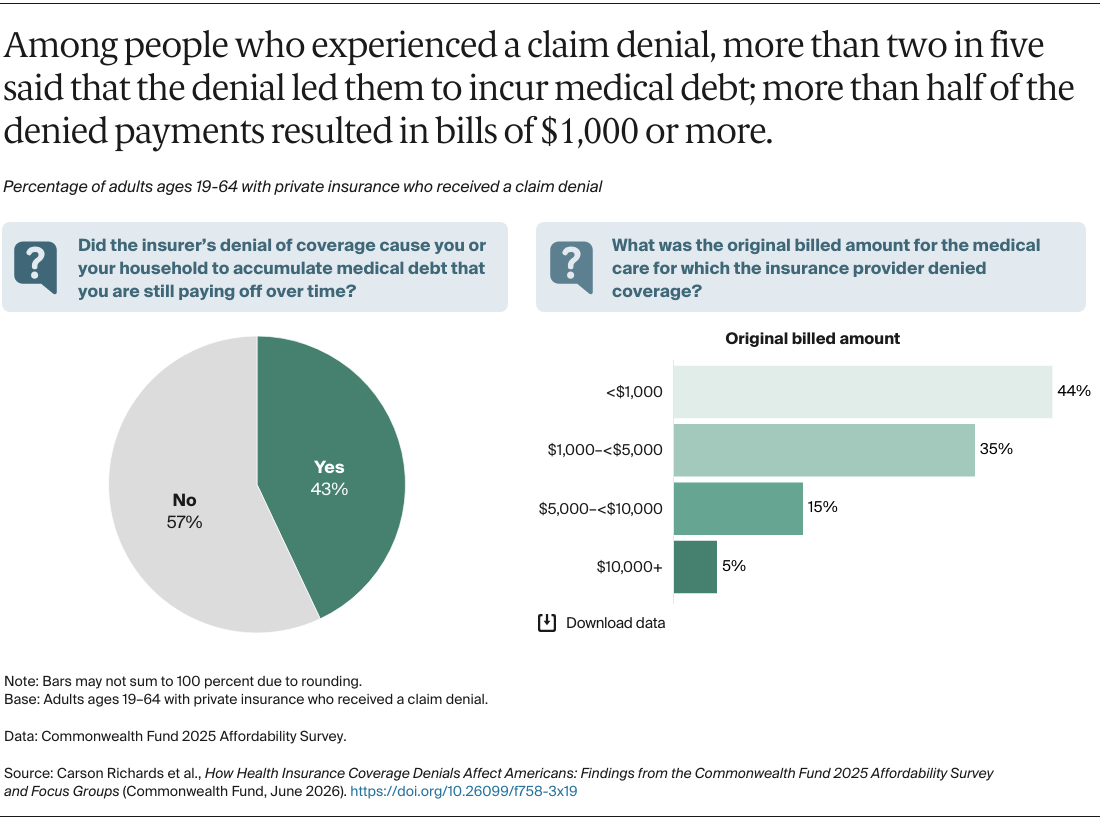
Richards_coverage_denials_Exhibit_03

Coverage denials can have serious financial consequences. More than two in five (43%) adults who had a claim denial said the denial caused them or their household to incur medical debt that they are still paying off. More than half of the adults said that their original bill was $1,000 or more.

For many focus group participants, the accumulation of medical debt because of a coverage denial had made them hesitant to get health care again. Worry about financial consequences of additional care further exacerbated the anxiety and stress they experienced.

Denied: Jaime’s Story

Jaime was at dinner with his wife when he lost consciousness. She called an ambulance from the restaurant, and Jaime was taken to the hospital. Arriving barely conscious, he was told the hospital was out of his plan’s network.

“Because of the type of insurance I have, they just said they couldn’t accept me due to the coverage. . . . I had to wait hours for them to call back and forth between the hospital and the insurance company before they finally allowed the hospital to provide coverage for me.”

Jaime’s insurance covered some of his tests at the hospital but not all of them — for example, they covered a magnetic resonance imaging scan but not an electrocardiogram. He said he was convinced that “anything they could find not to pay, basically, they didn’t.” A few months later, Jaime’s insurance notified him that they also would not cover the $3,000 ambulance bill.

Jaime was left with significant medical debt. He makes monthly payments, so the debt doesn’t affect his credit. He worries, however, about future medical bills.

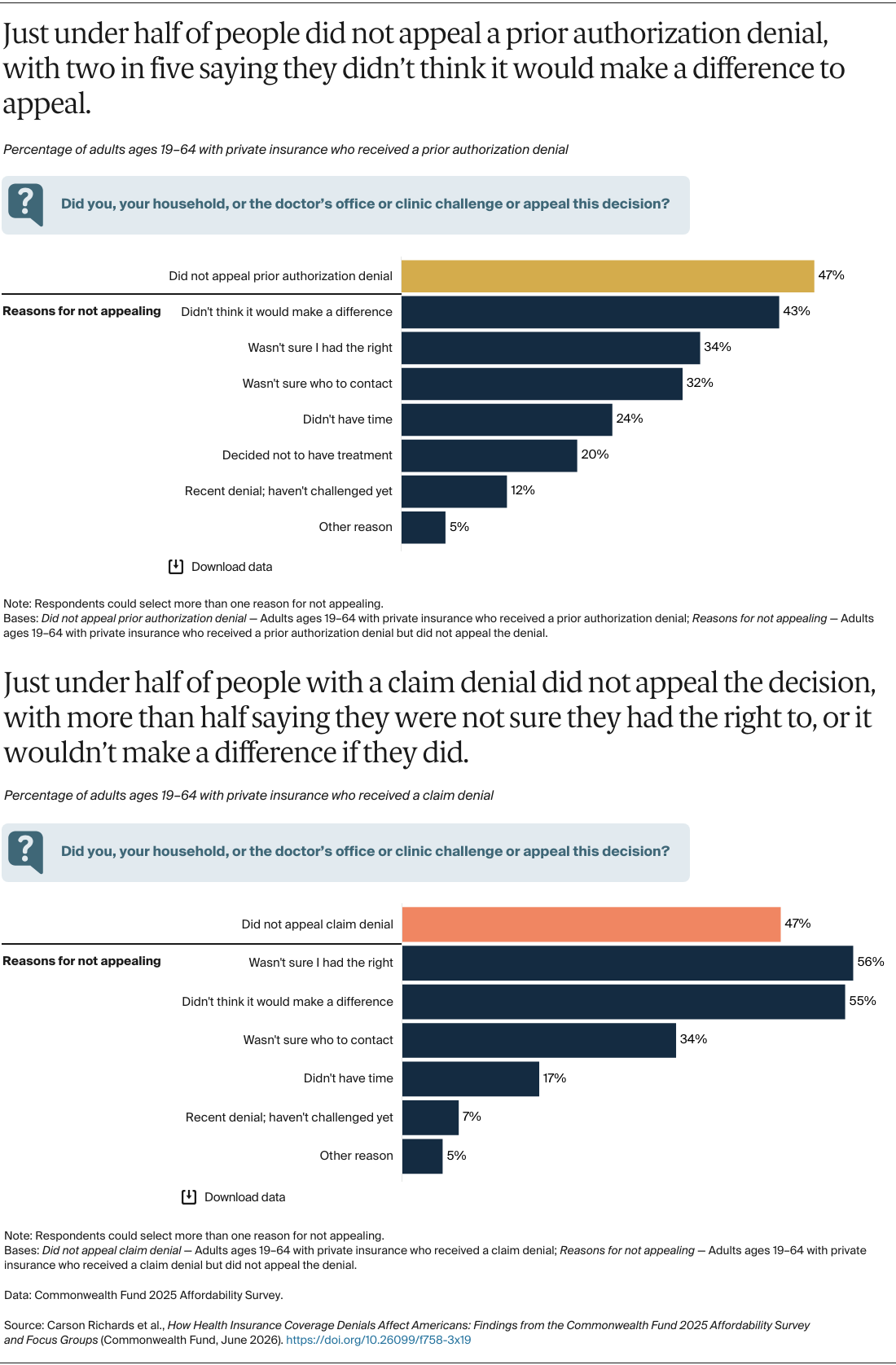
Richards_coverage_denials_Exhibit_04

Even though patients have a right to appeal an insurer’s decision to deny coverage for a health care service, only about half appealed. When asked why they didn’t appeal a coverage denial, many people believed it would not make a difference. Many also doubted they had a right to appeal a decision or expressed confusion about who they were supposed to contact.

Patients in focus groups described a time-intensive, confusing, and highly frustrating process to appeal coverage denials. They often weren’t sure if they should contest the denial with their provider or insurance company, or even why they should have to appeal at all, since the denial was for care their doctor recommended.

[I] gave it my all in appealing the whole situation. . . . I got the run around like, ‘Oh, you need to speak to this person.’ Then they transferred me back to that person and the phone would ring and ring, and I’d give a voicemail and they wouldn’t call me back for two or three days. I’m still fighting with them.

Sally, a woman in her 40s with a claim denial for ultrasound

Several focus group participants felt that appealing a coverage denial would be futile. One thought that insurance companies take advantage of patients’ lack of knowledge about the health system. Many expressed frustration with the lack of transparency from insurers, saying patients “have no clue what’s going to be covered” when a doctor recommends health care. Over time, this pattern eroded participants’ trust in both their health care providers and insurance plans.

I hate the way it felt like I got conned. . . . I think [the insurance companies] know that the average person is not going to ask the right questions or know the right information. They take advantage of that, which I think is terrible, especially . . . those who are elderly or anything like that who don’t have the help or the resources.

Jaime, whose claim for emergency care was denied

Richards_coverage_denials_Exhibit_05_v2

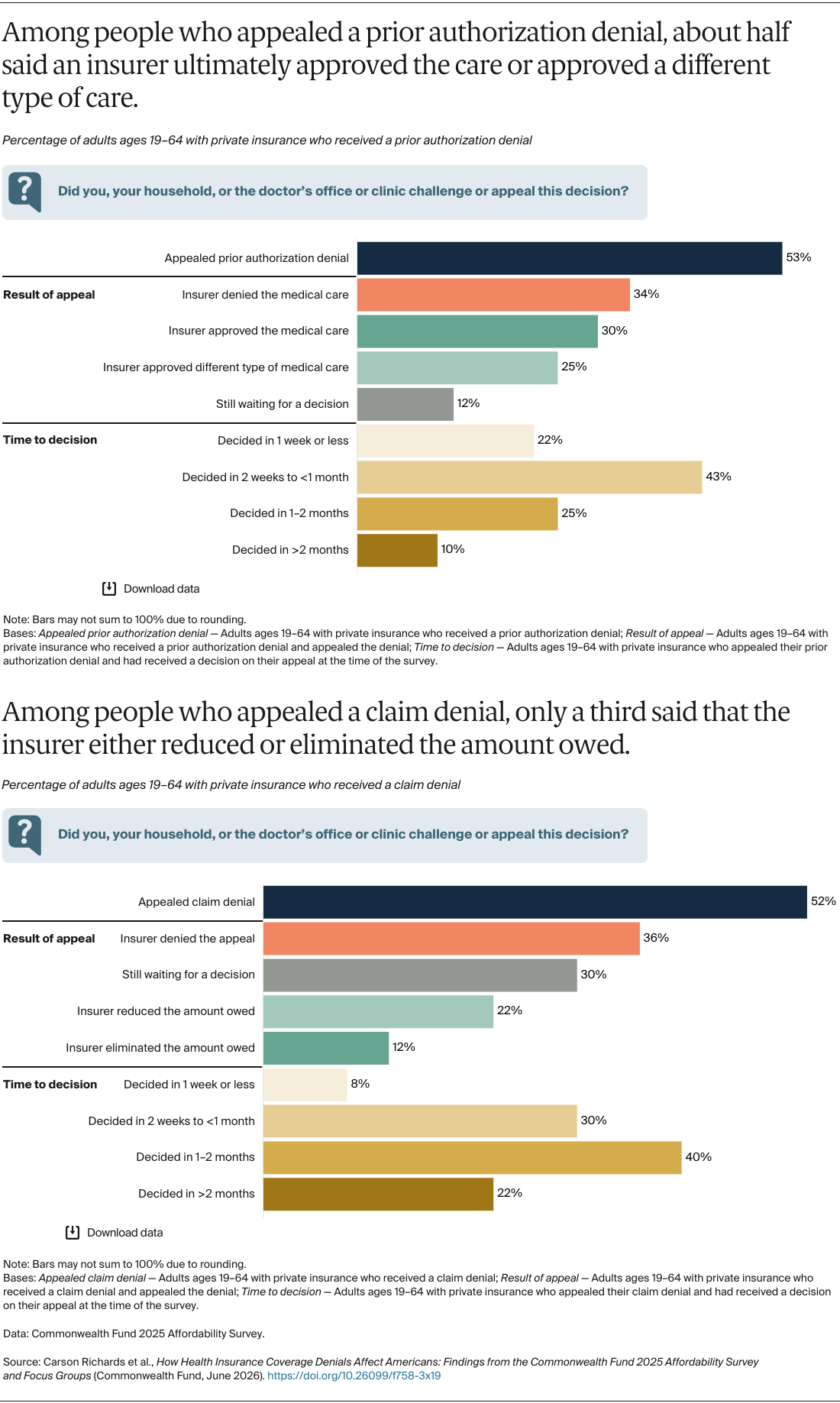
About half of people challenged their coverage denials, but they were not always successful. Among those who challenged prior authorization denials, 30 percent said that their insurer approved the recommended medical care, and a quarter received approval for a different type of care. But in one-third of appealed cases, the insurer continued to deny the care. Nearly 80 percent of people who challenged their prior authorization denial and had received a decision on their appeal at the time of the survey said they waited two weeks or more for their insurance company’s decision.

Among patients and their families who challenged a claim denial, only one-third (33%) said their insurer reduced or eliminated the amount of money they owed. Thirty-six percent said their insurer denied their appeal, similar to the share of people who were unable to reverse their prior authorization denials. More than 60 percent of those who challenged their claim denial and had received a decision on their appeal at the time of the survey said that their insurer took one month or more to reach a decision.

Some focus group participants described a time-consuming and stressful process to appeal coverage denials. They often felt “caught in the middle” between their provider and insurance company as they tried to navigate a system that seemed designed to work against them.

[The insurance company] said, ‘You’ve had enough [physical therapy appointments].’ My physical therapist [says I need more], he’s still arguing for me, but they said no. . . . It’s almost like they will always give you an initial denial and see whether or not you’ll actually fight them on it.

John, who had a prior authorization denial for physical therapy following shoulder surgery

Richards_coverage_denials_Exhibit_06

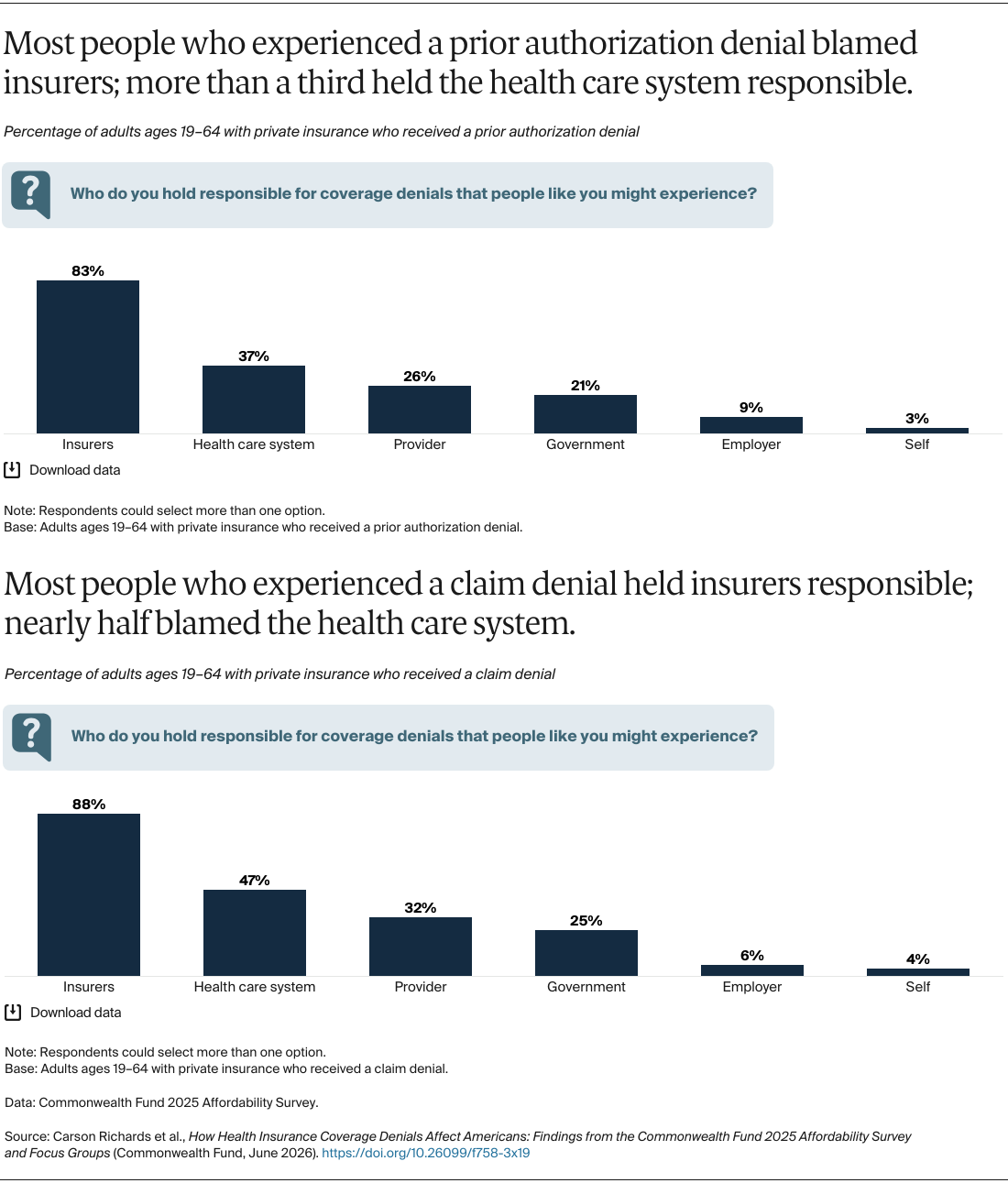
When asked who they held responsible for their coverage denial, nearly nine in 10 people blamed their insurance company. And many also blamed the health care system in general. Others viewed their providers as responsible for the denial, and more than one in five blamed the government for their experience.

In focus groups, some participants described how their ordeal with a coverage denial caused them to “totally lose trust” in their health care provider or insurance company, particularly when they had been explicitly told by at least one party that their care would be covered. Participants’ frustration with the health care system was palpable, and many remarked that insurance companies or the health system needed to change.

Denied: Nathan’s Story

Nathan didn’t anticipate a months-long fight with his insurance carrier while his wife battled cancer. Early in her treatment, the oncologist ordered genetic testing to look for mutations that would influence her response to therapies. Nathan and his wife were initially told that diagnostic genetic testing would be covered by their insurance, at least partially. But after the testing was completed, they were shocked to learn their insurance would not cover it.

Nathan began the frustrating process of contesting the denial. “You get in this loop of, holy cow, you ask eight people the same question. You get eight completely different answers.”

The couple eventually appealed to the oncologist, who submitted additional information to justify the necessity of the testing. While the insurance company elected to cover part of the testing, Nathan still couldn’t get a clear answer on his final bill amount.

What Can Government Do to Help Consumers?

Prior authorization can be a useful tool for protecting patients from low-value care that provides little benefit or might actually harm them. However, the processes insurers currently use lack clear rationales that patients and their providers can understand. Most troubling is that prior authorization is preventing patients from getting the care they need while placing additional burdens on physicians and their staff.

When asked what policymakers might do to help consumers, focus group participants said there should be greater transparency in insurer decision-making with “no ambiguity” in which procedures are covered. Some participants thought there should be external oversight by “another entity outside the insurers themselves” and said there must be clear reasons “why an insurance company is rejecting coverage, particularly when the test or procedure is ordered or recommended by a doctor.” There was also a desire for transparency to see where their premium dollars were going. Said one participant, “They are not using the money to pay for my care, and that is what frustrates me a lot.”

A Patchwork of Inadequate Laws and Regulations

The United States has a dated and patchwork system of regulations governing coverage denials and patients’ right to appeal them. Denial rules for employer plans have not been updated since 2000.2 In 2010, the ACA extended those rules to apply to all nongrandfathered individual and marketplace plans.3 While the Biden administration issued a new set of regulations on denials in 2024, these apply only to plans that fall under the jurisdiction of the Centers for Medicare and Medicaid Services (CMS), including marketplace plans in the 30 states that use the federal HealthCare.gov platform. They do not apply to employer plans or marketplace plans in states that run their own marketplaces.

Several states have passed laws that go further than federal requirements. States, however, lack jurisdiction over large, self-insured employers, which employ the majority of Americans.

In 2025, the largest U.S. health insurers announced a voluntary commitment to streamline prior authorization processes, including reducing the number of services subject to prior authorization and honoring preapprovals for a set period when people switch health plans.4

Clearly, there is a need to bring order to the fragmented set of laws governing coverage denials. Congress can accomplish this through standardization across all types of insurance and through the expansion and strengthening of rules regarding transparency in coverage decisions, oversight of insurers, and patients’ rights to appeal decisions. Options include:

Expanding the right to appeal. Consumers in nongrandfathered health plans, including employer plans, have the right to appeal coverage denials, and insurers are required to review and reconsider their decisions. If an insurer still denies coverage, patients have the right to an independent third-party review, and the insurer must accept the outcome of that review.

However, federal regulations restrict third-party appeals to denials based on medical necessity, which one study found made up just 5 percent of all denials.5 The majority of denials are for unspecified reasons, administrative issues, excluded services, and lack of referral or prior authorization.6 Consumers would be better served if all denials were eligible for external review.

Standardizing and streamlining prior authorization procedures in all health plans. The Biden administration issued a rule in 2024 seeking to increase transparency and standardization of prior authorization procedures for insurers selling plans in the 30 marketplaces that use HealthCare.gov, as well as those in other public programs.7 Beginning in January 2027, these payers must maintain a secure electronic portal with their list of covered items and services, documentation requirements for prior authorization, and a record of prior authorization requests and responses. CMS recently introduced a new proposed rule that would extend these requirements to prior authorization of prescription drugs.8

The federal government could expand both rules to cover all marketplace and employer plans. It also could require much greater transparency about insurer criteria for selecting services that need prior authorization.9

Learning from states’ approaches to prior authorization. At least 10 states have implemented a “gold card” approach for providers that reach a threshold level of prior authorization approvals. This enables providers to deliver certain services or prescribe drugs without seeking prior authorization.10 Several other states have shortened timelines for insurers to respond to prior authorization requests, required reviewers to meet clinical qualifications, or exempted or limited some services from prior authorization review, such as mental health care or care for chronic conditions. Although these state actions do not affect people in self-insured employer plans, they can inform federal policy.

Funding consumer assistance programs. The ACA authorized Consumer Assistance Program (CAP) grants to help states establish or strengthen services for patients to inform them of their rights and help them resolve health plan disputes. In the first year, CAP grants allowed states to recover more than $18 million for patients.11

Although federal funding for CAP grants has ended, the programs still exist in 31 states and the District of Columbia and continue to save consumers money (for example, Connecticut recovered $4.3 million for patients in 2021).12 Reinstating federal funding could help establish CAPs in the 20 states that currently don’t have them.

Reporting health care claim denials and appeals. The ACA requires all nongrandfathered health plans, including all employer plans, to report data on claim denials, the reasons for the denial, and the total number of denied and appealed claims.13 However, the federal government has limited enforcement to just marketplace plans sold through 30 marketplaces operated by the federal government. The Biden administration’s 2024 rule increases data reporting requirements for these plans, but patients may not be aware that this information is available on an insurer’s website.14 Expanding public reporting of these decisions to include all marketplace plans and employer plans — and making the data accessible and understandable to consumers on publicly accessible websites — would further the public’s understanding of insurer practices.


HOW WE CONDUCTED THIS SURVEY

The Commonwealth Fund 2025 Affordability Survey was administered by SSRS from July 22 to October 27, 2025. The survey consisted of telephone and online interviews in English and in Spanish and was conducted among a random, nationally representative sample of 6,353 adults ages 19 to 64 years living in the United States. The survey interviews were completed via a multiframe approach, which included address-based samples (ABS), prepaid cell phone samples, and the SSRS Opinion Panel. Interviews were conducted online or on the phone via ABS (n=1,794), via prepaid cell phones (n=328), and online via the SSRS Opinion Panel (n=4,231).

The sample was designed to exclude anyone age 65 and older, while also allowing for a sufficient sample of those anticipated to experience more health care affordability challenges (such as coverage denials, billing errors, or medical debt). Statistical results were weighted in stages to compensate for sample designs and patterns of nonresponse that might bias results. In the first stage of weighting, base weights were applied to account for sampling probabilities and were computed separately for each of the three sample frames. The base-weighted samples were combined using a compositing adjustment. Finally, the combined sample was calibrated to match target population benchmarks.

The resulting weighted sample is representative of the approximately 196 million U.S. adults ages 19 to 64. The survey’s margin of sampling error is +/– 1.5 percentage points at the 95 percent confidence level. The ABS portion of the survey achieved a 14.4 percent response rate, the prepaid cell portion achieved a 1.5 percent response rate, and the SSRS Opinion panel portion achieved a 2.5 percent response rate.

This brief focuses on 4,589 adults in the survey with private insurance. The resulting weighted sample is representative of approximately 130.6 million adults ages 19 to 64 with private insurance. The margin of sampling error for the subgroup of those with private insurance is +/– 1.7 percentage points at the 95 percent confidence level.

SSRS conducted eight online focus groups in April 2025, prior to fielding the survey. Six focus groups were in English, and two were in Spanish, with a total number of 45 participants. The focus groups informed the development of survey questions designed to capture people’s experience with coverage denials, billing errors, and medical debt. This brief highlights the experiences of the 27 participants who experienced coverage denials.

ACKNOWLEDGMENTS

The authors thank the SSRS team of Darby Steiger, Melissa Silesky, and Robyn Rapoport for conducting and summarizing findings from the focus groups, and Paula Armendariz, Elizabeth Sciupac, and Ms. Rapoport for their work on the survey. They also thank Chris Hollander, Paul Frame, Jen Wilson, Tony Shih, Arnav Shah, Paige Huffman, Munira Gunja, and Karina Polanco, all of the Commonwealth Fund. Additionally, they thank Justin Giovannelli and Kevin Lucia of Georgetown University for helpful comments.

Notes

Publication Details

Date

Contact

Sara R. Collins, Senior Scholar, Expanding Coverage and Access and Tracking Health System Performance, The Commonwealth Fund

[email protected]

Citation

Carson Richards et al., How Health Insurance Coverage Denials Affect Americans: Findings from the Commonwealth Fund 2025 Affordability Survey and Focus Groups (Commonwealth Fund, June 2026). https://doi.org/10.26099/f758-3x19